I have posted previously from Elizabeth Shane‘s “Tales of the Donegal Coast and Islands”
As I posted before, Shane – despite her claim that “Dialect in verse is apt to become burdensome” and that “I have therefore not attempted to do more than suggest the speech of the district by occasional spelling, and by a characteristic turn of the sentences” – is somewhat dialect heavy for my taste (and I don’t think “’tis” is particularly a Donegal turn of speech). However this poem – which follows a Donegal native prone to “sailin’ near/Where the rollin’ waves do break/ On the rocks off Gola” to a munition factory in what I would presume to be Glasgow – does also illustrate a neglected group of emigrants (and a neglect branch of emigrant work)
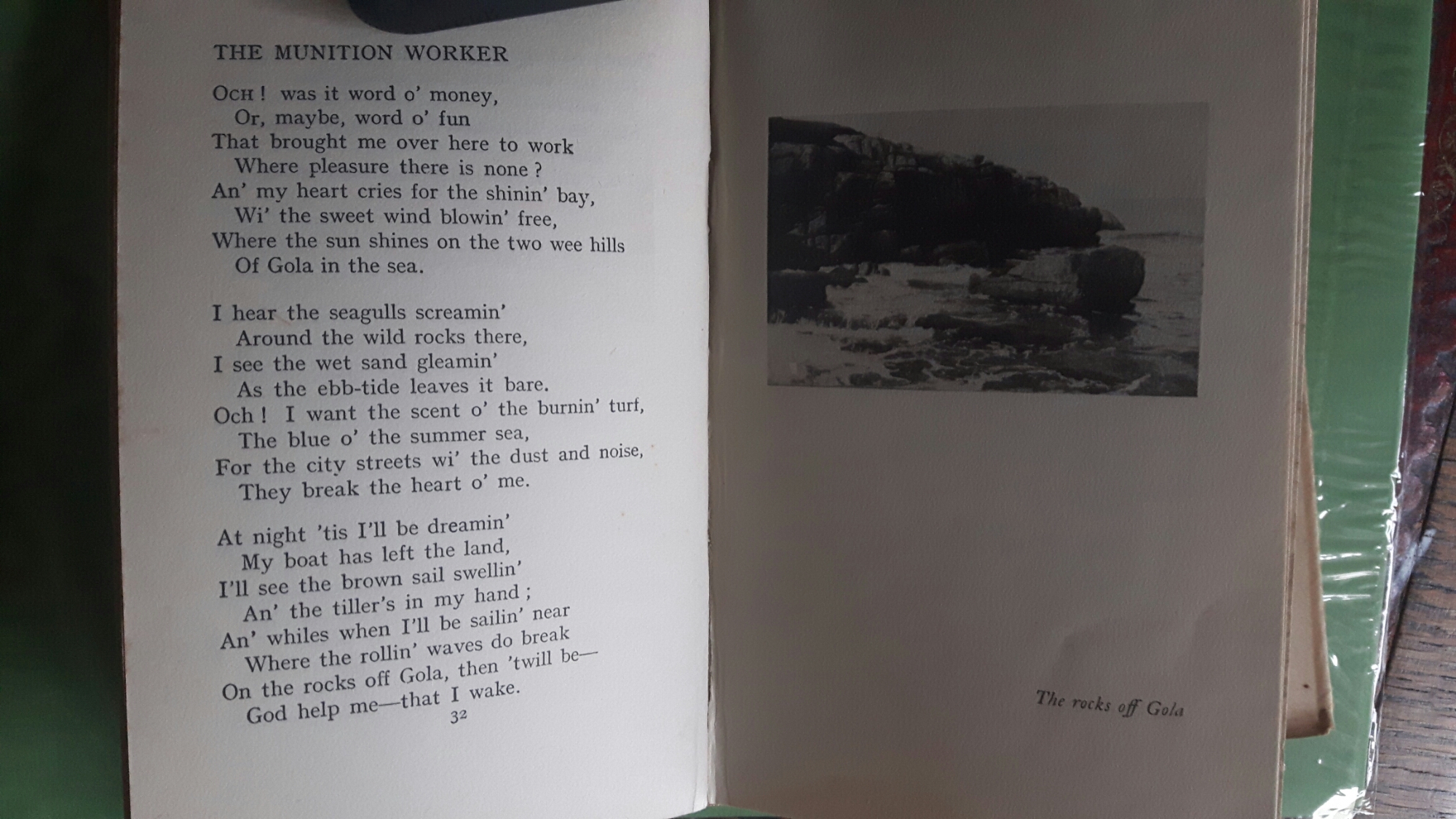
The Munition Worker
Och! Was it word o’money,
Or, maybe, word o’fun,
That brought me over here to work
Where pleasure there is none?
An’ my heart cries for the shinin’ bay,
Wi’ the sweet wind blowin’ free,
Where the sun shines on the two wee hills
Of Gola in the sea.
I hear the seagulls screamin’
Around the wild rocks there,
I see the wet sand gleamin’
As the ebb-tide leaves it bare.
Och! I want the scent o’ the burnin’ turf,
The blue o’ the summer sea,
For the city streets wi’ the dust and noise,
They break the heart o’ me.
At night ’tis I’ll be dreamin’
My boat has left the ladn,
I’ll see the brown sail swellin’
An’ the tiller’s in my hand;
An’ whiles when I’ll be sailin’ near
Where the rollin’ waves do break
On the rocks off Gola, then ’twill be –
God help me – that I wake.
Och! What’s the use o’ money,
An’ sure no fun can be
When the heart is breakin’ in you
For a place you cannot see.
‘Tis the houses here are black wi’ smoke,
An’ the sky is black above,
But the sun shines on the wee brown hills
Of Gola that I love.

 Séamus Sweeney